
Introduction: Is it ever right to ask for foreign help to topple a dictatorship?
Hello. This month, we will explore one of the most controversial questions in Political Science: Is it legitimate and ethical to seek foreign help to overthrow a dictatorship? To search for an answer, let us take a brief journey through world history.
What the history tells us?
The famous revolutionary Che Guevara, during his years in Argentina, took part in actions against the country’s dictator Juan Perón. Years later, he reflected on those days with these words: “Back then, as we struggled to overthrow Perón, we were waiting for help from abroad. Time taught us that this was a great mistake. A dictator, no matter how cruel, must be brought down from within, not from outside.” Che’s words capture the very essence of the revolution he later achieved with Fidel Castro, when they overthrew Cuba’s military dictator Fulgencio Batista — from within.
Another painful example from Latin America is the regime of Augusto Pinochet, who ruled Chile with an iron fist for years. Coming to power through a bloody coup, Pinochet tortured and executed thousands in stadiums. Yet, after a long struggle for democracy, the Chilean people buried his regime through a nationwide referendum — by their own hands.
From Latin America, let us move to one of today’s most debated cases: Venezuela. President Nicolás Maduro has silenced all opposition by manipulating the electoral system. Much of the opposition — and even a large portion of the population — now appeals to the United States for help, as others did in the past. But one cannot help but ask: Has any U.S.-backed intervention ever truly delivered democracy?
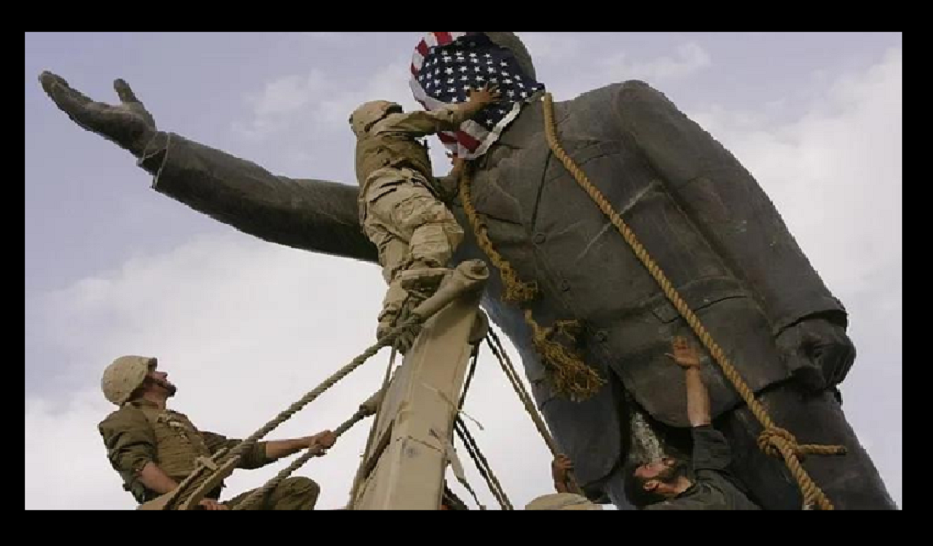
To answer that, we must turn our eyes to the Middle East. In the 1990s, Iraq’s feared dictator Saddam Hussein was finally captured in a pit in 2003. The Iraqi people rejoiced; statues were torn down, and American flags waved in the streets. But the years that followed left Iraq divided along ethnic and sectarian lines — a nation trapped in chaos.
The next target of the United States was Libya’s strongman Muammar Gaddafi. After decades of authoritarian rule, Gaddafi was overthrown through NATO’s intervention and brutally lynched by his own people. Yet what followed was not freedom, but civil war. Today, Libya remains one of the most unstable countries in the world.
A similar tragedy unfolded in Afghanistan. A land repeatedly invaded throughout history, Afghanistan has never known lasting peace. First came the Soviet occupation supporting a socialist government; then the U.S. armed Islamist militias to fight them. Each intervention dragged the country deeper into endless turmoil. By continually inviting foreign powers into its internal crises, Afghanistan ultimately fell into the darkness of the Taliban regime.
Today, the world’s attention turns to the land of Persia — Iran. In 1979, the Iranian people rose up and overthrew the Shah’s regime, hoping for freedom and justice. But soon, the Khomeini regime hijacked the revolution, purging liberal and leftist groups and transforming the country into a strict theocracy that still rules today. In modern Iran, street protests are brutally crushed, and dissidents are accused of being “agents of the United States.” Now, the only visible alternative to the regime seems to be the exiled heirs of the Shah — who themselves seek foreign backing.
Turning to the present, the Syrian civil war—ignited in 2011 and raging for 14 grueling years—finally toppled the Bashar al-Assad regime in December 2024. The Syrian people were liberated from their dictator, but not without the crucial backing of Western powers and regional neighbors like Turkey (Türkiye) and Jordan. Now, the burning question lingers: What comes next? Can free elections be held under impartial oversight? Will the country’s diverse factions—Kurds, Turkmen, Druze, and Alawites—find fair representation in the new leadership? In short, will this externally aided freedom pave the way for a democratic order, or descend into the chaos and fragmentation we’ve seen before? Only time—and the vigilance of the Syrian people—will tell.
Conclusion: Freedom cannot be imported
History teaches us a simple truth: No nation can achieve its freedom through help that comes from outside. Foreign interventions may appear to bring salvation in the short term, but they inevitably create new dependencies and chaos in the long run. Some may point to post-war Germany or Japan as counterexamples of successful foreign involvement. Yet those were not simple regime changes — they were complete societal reconstructions under unique historical conditions that cannot be replicated elsewhere. True freedom is born only from within — through a people’s own courage, awareness, and collective will. Because freedom is not a commodity to be imported; it is a value forged by the consciousness of a nation.
Ali EKİNCİEL