
The Middle East has once again become the epicentre of global geopolitical tension. Yet unlike previous eras, contemporary conflicts in the region are no longer driven solely by ideological rivalries, territorial disputes, or conventional military competition. Instead, the region increasingly represents the central arena of a broader struggle over energy security, maritime dominance, strategic trade corridors, and the future architecture of global power.
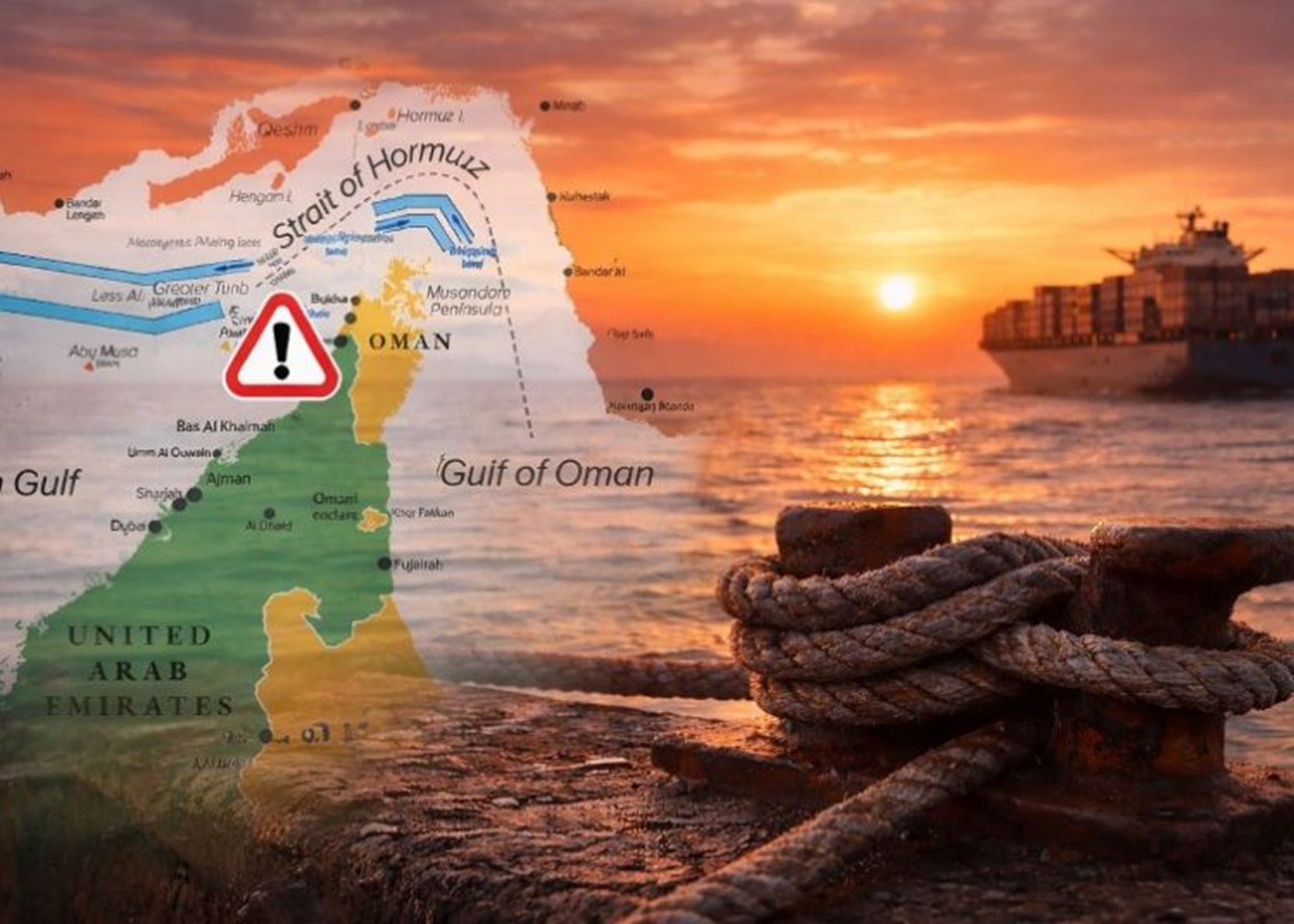
At the heart of this fragile geopolitical landscape lies the Strait of Hormuz — one of the world’s most strategically vital maritime chokepoints. Connecting the Persian Gulf to the Arabian Sea and international waters, the Strait functions as the primary artery of global hydrocarbon transportation. According to the U.S. Energy Information Administration (EIA), nearly one-fifth of the world’s daily oil consumption and a substantial portion of global liquefied natural gas (LNG) exports pass through this narrow waterway every day (EIA, 2024). Consequently, even minor instability in the region can generate immediate repercussions across global financial markets, energy prices, international shipping networks, and inflationary dynamics.
Today, the escalating confrontation between Iran and the United States has transformed the Strait of Hormuz into one of the most volatile strategic flashpoints of the international system. Recent years have witnessed repeated tanker seizures, drone attacks on oil facilities, cyber operations targeting energy infrastructure, increasing naval deployments, and rising rhetoric surrounding potential military escalation. These developments collectively reveal that the Strait of Hormuz is no longer merely an energy transit route. Rather, it has evolved into a geopolitical pressure mechanism capable of reshaping global economic stability within hours.
To fully understand the significance of the Hormuz crisis, it is essential to recognise the broader transformation occurring within international politics. In the 21st century, energy has become one of the primary instruments of geopolitical influence. States no longer compete solely through territorial expansion or military superiority; they increasingly compete through the control of pipelines, maritime corridors, energy infrastructure, and strategic logistics networks.
Within this context, maritime chokepoints have acquired unprecedented geopolitical importance. The Strait of Hormuz, alongside the Bab el-Mandeb Strait and the Suez Canal, represents a critical component of the global trade system. Any disruption in these routes directly threatens not only regional economies but the broader structure of globalisation itself.
Iran’s strategic approach toward the Strait of Hormuz reflects a sophisticated asymmetric security doctrine shaped by decades of regional confrontation and international sanctions. Unlike conventional military powers that rely primarily on large-scale force projection, Tehran has developed a deterrence strategy centred on missile systems, naval asymmetry, proxy warfare networks, and geographical leverage (Cordesman, 2020).
From Tehran’s perspective, geography itself functions as a strategic weapon. The Strait’s narrowness enables Iran to project disproportionate influence despite economic and military constraints. This reality explains why Iranian officials have repeatedly emphasised the possibility of restricting maritime traffic in response to external pressure or military threats.
The importance of this strategy has become increasingly evident following heightened tensions surrounding Iran’s nuclear program and the collapse of diplomatic momentum after the United States withdrew from the Joint Comprehensive Plan of Action (JCPOA). Since then, the Gulf region has experienced a cycle of escalating instability characterised by tanker incidents, targeted attacks on oil infrastructure, and intensified proxy warfare dynamics.
The United States, however, continues to perceive uninterrupted Gulf energy flows as a fundamental strategic interest. Since the Carter Doctrine of 1980, Washington has maintained that any attempt to obstruct the free movement of Gulf oil would be regarded as a direct challenge to U.S. national security interests (Gause, 2010). Consequently, the Persian Gulf remains one of the most militarised regions in the world despite broader American efforts to redirect strategic focus toward competition with China in the Asia-Pacific.
The presence of U.S. naval fleets, air defence systems, and regional military partnerships demonstrates that Washington’s Gulf strategy extends far beyond energy itself. At stake is the preservation of a broader international order in which maritime security and global trade routes remain under Western strategic protection.
Nevertheless, the Hormuz crisis cannot be analysed merely through the lens of bilateral hostility between Tehran and Washington. Its implications are fundamentally global.
Europe, already weakened by the energy consequences of the Russia–Ukraine War, remains highly vulnerable to additional disruptions in global energy markets. Following the reduction of Russian gas supplies, European states have accelerated efforts to diversify energy imports through LNG agreements, alternative pipeline projects, and Middle Eastern partnerships. Under these conditions, a major disruption in Gulf shipping routes could dramatically intensify inflationary pressures, energy shortages, and industrial stagnation across European economies.
Asian economies face even greater risks. China, India, Japan, and South Korea remain heavily dependent on hydrocarbons from the Gulf to sustain industrial production and economic growth. China in particular has significantly expanded its strategic and economic engagement across the Middle East through the Belt and Road Initiative (BRI), infrastructure investments, and long-term energy agreements (Leverett & Bingbing, 2016).
For Beijing, stability in the Persian Gulf is directly connected to long-term economic sustainability. Consequently, the Hormuz crisis increasingly intersects with broader U.S.–China strategic competition. The Gulf is no longer simply a regional energy zone; it has become a critical arena within the emerging multipolar international system.
Russia’s position within this evolving equation is equally significant. Prolonged instability in Gulf energy routes would likely increase global oil and gas prices, thereby strengthening Moscow’s export revenues and geopolitical leverage. In this sense, the Hormuz crisis indirectly contributes to the restructuring of global energy politics and great-power competition.
Another defining characteristic of the contemporary Middle East security environment is the growing role of non-state actors and proxy warfare structures. Groups such as Hezbollah in Lebanon, the Houthis in Yemen, and various Iran-backed militias in Iraq and Syria increasingly function as strategic extensions of regional influence.
These actors possess the capacity to target energy facilities, ports, pipelines, and shipping corridors without necessarily triggering direct interstate warfare. The attacks on Saudi Aramco facilities in 2019 demonstrated how vulnerable global energy infrastructure has become to asymmetric warfare strategies. Despite being relatively limited in scale, the attacks temporarily disrupted nearly half of Saudi Arabia’s oil production capacity and caused immediate volatility in international markets (International Energy Agency, 2020).
This incident revealed a broader transformation in the nature of conflict itself. In contemporary geopolitical competition, pipelines, refineries, LNG terminals, ports, and undersea infrastructure have become strategic targets. Energy systems are no longer merely economic assets; they are increasingly integral components of national security architecture.
As a result, global powers have intensified efforts to develop alternative energy corridors to reduce dependence on vulnerable maritime chokepoints. Projects such as the India–Middle East–Europe Economic Corridor (IMEC), Eastern Mediterranean energy initiatives, and Eurasian pipeline networks increasingly reflect attempts to restructure global trade and energy geography.
Within this evolving strategic environment, Turkey occupies an increasingly critical geopolitical position. Situated at the crossroads of Europe, Asia, the Caucasus, and the Middle East, Turkey has gradually transformed into one of Eurasia’s most important energy transit hubs.
Projects such as TANAP, TurkStream, and the Baku–Tbilisi–Ceyhan pipeline have significantly strengthened Ankara’s strategic relevance within international energy calculations. As concerns over Gulf instability intensify, alternative transit routes through Anatolia may become even more valuable for European and Asian energy diversification strategies.
This development could substantially enhance Turkey’s geopolitical influence in the coming decades. Beyond its traditional regional role, Ankara may increasingly emerge as a central actor within the future architecture of global energy security.
Ultimately, the Strait of Hormuz crisis represents far more than a regional confrontation between Iran and the United States. At stake is the stability of the global economy, the security of international trade routes, and the future balance of power within the international system itself.
The world is entering a new geopolitical era in which maritime chokepoints, energy corridors, and strategic infrastructure will increasingly shape international relations. In this evolving order, energy security is no longer merely an economic issue; it has become one of the defining pillars of geopolitical power.
For this reason, the Middle East continues to function not only as a regional conflict zone but also as the epicentre of a broader global struggle over energy, trade, and strategic influence. The Strait of Hormuz, therefore, remains one of the most consequential geopolitical fault lines of the 21st century.

Dr. Hande ORTAY
REFERENCES
- Byman, D. (2018). Proxy Wars: Suppressing Violence through Local Agents.
- Cordesman, A. H. (2020). Iran and the Changing Military Balance in the Gulf. Center for Strategic and International Studies.
- EIA (2024). World Oil Transit Chokepoints. U.S. Energy Information Administration.
- Gause, F. G. (2010). The International Relations of the Persian Gulf. Cambridge University Press.
- International Energy Agency (2020). Oil Market Report.
- Klare, M. T. (2019). The Race for What’s Left: The Global Scramble for the World’s Last Resources.
- Leverett, F., & Bingbing, W. (2016). The New Silk Road and the Gulf.
- Mearsheimer, J. J. (2014). The Tragedy of Great Power Politics. W.W. Norton & Company.