
Beşiktaş Gymnastics Club (BJK)—one of the three biggest sports clubs in Istanbul and Türkiye, alongside Galatasaray and Fenerbahçe—is a prominent institution with deep historical roots, founded in 1903 during the Ottoman Empire, and boasts a vast fan base. Although the club is best known for its football team—frequently referred to as the “Black Eagles” (Kara Kartallar)—it is a major sports organization that operates across many disciplines. Beşiktaş is currently in the spotlight due to a contentious match in Georgia between its football team and the Israeli side Hapoel Be’er Sheva. This article summarizes the situation.
The humanitarian tragedy in Gaza in recent years has brought Türkiye-Israel relations to a breaking point, a situation that has now begun to affect international sporting events involving teams from the two countries. Despite the tensions between the two states and their societies, UEFA has continued to pair teams from these nations against one another. Consequently, Beşiktaş was forced to play its match against Maccabi Tel Aviv—originally scheduled for November 28, 2024, in Istanbul—in Hungary behind closed doors; unable to leverage its home-field advantage, the team ultimately lost the match. Furthermore, yesterday (November 26, 2024), in accordance with a UEFA decision, Beşiktaş was compelled to play its scheduled Istanbul match against the Israeli side Hapoel Be’er Sheva in Georgia—this time with spectators present.

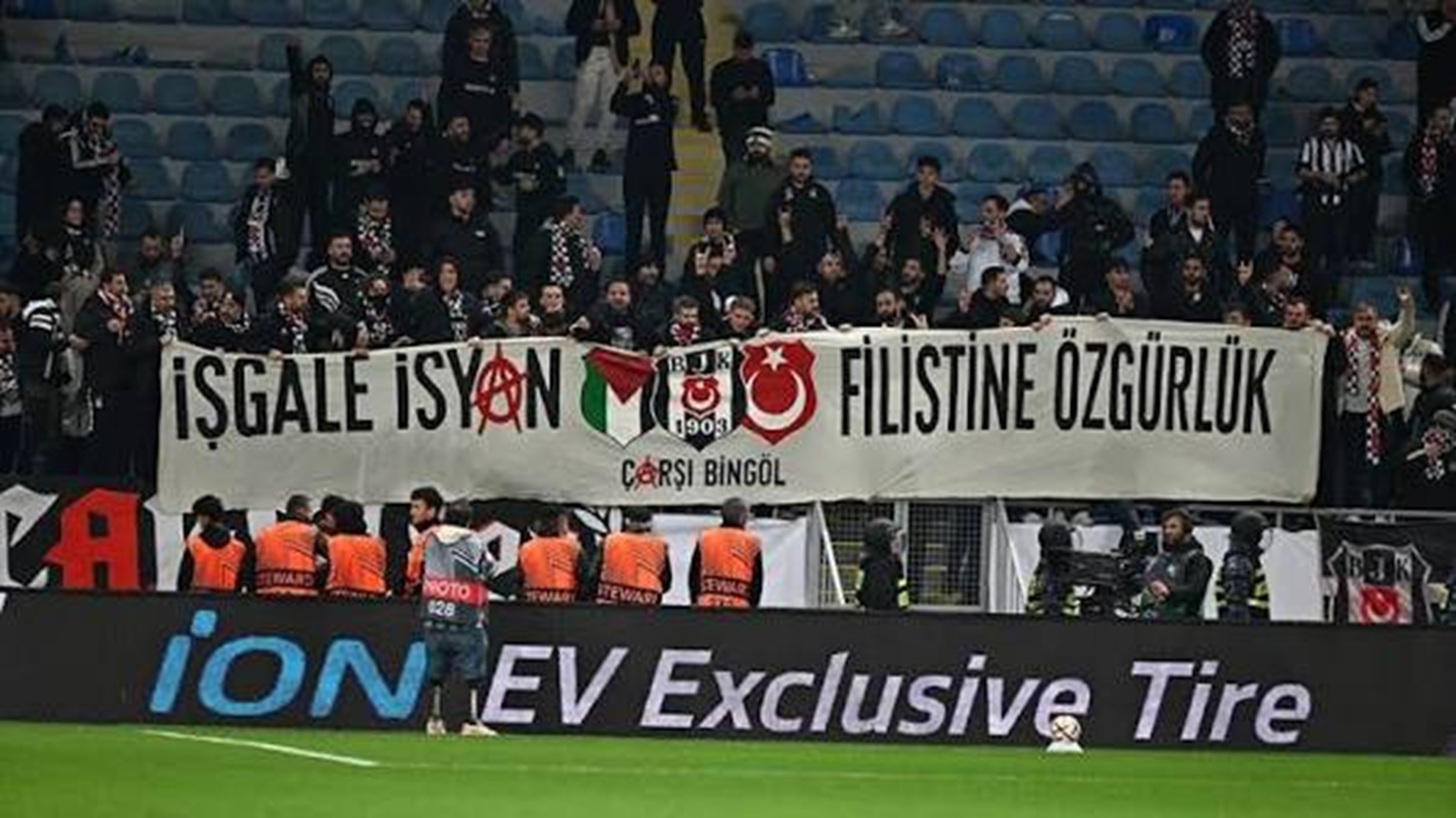
However, as many commentators who follow both international politics and football had anticipated, the match—driven by the sensitivities of Turkish Beşiktaş fans regarding the Palestinian cause and the genocide unfolding in Gaza—soon transcended the nature of an ordinary sporting event, effectively turning into a clash between civilizations. Already on edge, the Beşiktaş supporters lost their composure following a harsh intervention by the Georgian police against fans who had unfurled a Palestinian flag, leading to what was essentially a small-scale conflict in the stands. Although both Georgia and the Republic of Türkiye are two peaceful states and nations that recognize both Israel and the State of Palestine, the police’s harsh intervention against individuals carrying Palestinian flags caused tension among supporters and players, forcing a half-hour suspension of the match.
Fortunately, the match ended without further incident, with Beşiktaş securing a 2-1 victory. However, the events during the match led to the Georgian Ambassador to Ankara being summoned to the Ministry of Foreign Affairs today, resulting in a minor diplomatic crisis in relations between the two states. Although the crisis was averted thanks to the mature approach taken by both sides, the risks of fostering an intense political atmosphere within sporting events have, once again, become clear. In this regard, it is worth examining UEFA’s intentions, as it has repeatedly pitted Turkish and Israeli teams against one another.
It is quite striking that while UEFA has imposed significant isolation on Russian athletes and teams due to the war in Ukraine, it has failed to take any action regarding Israel—despite the fact that the situation in Gaza has led to equal, if not far greater, human suffering. In our view, either the same principles must be applied to everyone, or a clear, firm line must be drawn between sports and politics, ensuring that athletes and teams are not held accountable for the actions of their respective governments. Both in Russia and in Israel, there are millions of peace-loving individuals—including athletes—who oppose war. Therefore, rather than restricting sports and cultural activities to take a stand against war, other diplomatic tools should be used. After all, sports and the arts can inspire people to pursue peace. In this sense, permitting such activities could, in fact, positively affect the influence populations exert over their governments, potentially opening the door to peace. Naturally, however, it is essential to ensure that societies and states already experiencing significant internal tension are not pitted against one another as rivals.
Ultimately, although the events in Georgia concluded with only a few minor injuries, some arrests, and a small diplomatic crisis, it is necessary to put an end to Israel’s actions in Gaza and to normalize Türkiye-Israel relations in order to prevent the recurrence of such incidents. Furthermore, treating the Palestinian flag as if it were an element of a crime is unjust; the State of Palestine is an independent state recognized by hundreds of nations around the world.
In closing, we extend our best wishes to the Beşiktaş team, and we hope that no similar incidents occur during the match against Omonia—to be played in Southern Cyprus this January—and that the encounter takes place in a friendly atmosphere.
Prof. Dr. Ozan ÖRMECİ