
Introduction
Football continues to play an important role in Turkish political life. While Turkish national team matches often create a sense of unity and national rejuvenation, especially after successes in major tournaments such as the 2002 FIFA World Cup or EURO 2008, at other times, ethnic and religious cleavages within the country can also be reflected in football. A recent example of this is the promotion of Diyarbakır-based Amed SFK, also known as Amedspor, to Türkiye’s top-tier football division, the Super League (Süper Lig). In this piece, I will analyse the Amedspor phenomenon and discuss why this team’s success has sparked political discussions in Türkiye.
Amedspor’s History
Amed SFK, or Amedspor, is a Turkish football team established in 1972 in Diyarbakır, Türkiye’s densely Kurdish-populated metropolitan city. The club began its activities under the name Melikahmet Turanspor, aiming to develop Diyarbakır’s sports culture, introduce young people to sports, and create lasting sporting values for the city. In 1985, the club’s name was updated to Melikahmetspor. In 1990, at the peak of PKK’s terrorist activities in the country, which almost led to a civil war situation, the club became part of the Diyarbakır Municipality and continued under the name Diyarbakır Belediyespor. Strengthening its institutional structure with this Belediyespor identity, the club rose from amateur to professional leagues, achieving a stable position in Turkish sports. During this period, the club expanded beyond football to include boxing, volleyball, basketball, table tennis, bridge, and other sports, becoming a multi-sport club.
In 1993, following administrative and structural changes, the club’s name was changed to Diyarbakır Büyükşehir Belediyespor. During this period, the emphasis on youth development, support for young and local athletes, and promotion of sports across various disciplines became the club’s core approach. After 1999, the club, which took the prefix of DİSKİ, an institution within the Metropolitan Municipality, operated as Diyarbakır Metropolitan Municipality DİSKİspor until 2010. Between 2010 and 2015, the DİSKİ prefix was removed, and the club competed again as Diyarbakır Metropolitan Municipalityspor.
2014 marked a historic turning point for the club. With a general assembly decision, the club’s name was changed to Amed Sportif Faaliyetler Kulübü (Amed Sports Activities Club). This change symbolised the beginning of a new era that more strongly reflected the club’s belonging to the city, its cultural ties, and its sense of social responsibility. This year (2025-2026 season), the club delivered an outstanding performance and finally secured promotion to Türkiye’s top division, the Super League (Süper Lig). This was celebrated by Kurdish-origin citizens of Türkiye and is embraced as a step towards developing the underdeveloped Kurdish regions of Türkiye. However, the racist and secessionist reactions shown towards the club, due to its title (Amed is the historical Kurdish name of Diyarbakır), its Kurdish identity, and continuous physical attacks towards the club’s players in recent years, sparked a new political controversy in the country. In that sense, the club can be compared to pro-Kurdish political parties in Türkiye, which are forced to change their names frequently due to legal decisions (HEP, DEP, HADEP, DEHAP, DTP, BDP, HDP, DEM Party, etc.) and ostracised due to their Kurdish identity and alleged links with the outlawed PKK terrorist organisation.
Amedspor Controversy
Attacks towards Amedspor and its players have been occurring since 2015, due to high tension and polarisation in Türkiye related to PKK terrorism and the Kurdish Question. If we have to summarise the sequence of attacks from Prof. Dr. Cem Terzi;
- The 2015–2016 season was a turning point in this difficult period. During a Turkish Cup match against Sakaryaspor, some fans invaded the pitch and attacked Amedspor players. This incident went beyond mere crowd violence; it was a manifestation of political targeting on the field.
- In 2016, Deniz Naki, then playing for Amedspor, was handed a 12-match ban and a fine by the Turkish Football Federation (TFF) for a social media post advocating for an end to conflict and peace. This punishment violated freedom of expression. The incident did not end there. Naki stated that he was being targeted, faced intense media pressure, and was the victim of a gun attack on a highway in Germany in 2018.
- Between 2016 and 2018, Amedspor’s away matches consistently became sources of tension. Racist slogans, objects thrown onto the pitch, security lapses… This was no coincidence. This was the organised manifestation of social polarisation in the stands. Not a single match was played without incident. Amedspor was fighting not only against opposing teams, but also against racist attacks.
- In 2019, the investigation launched over a banner that read “Let the children not die, let them come to the match” marked another turning point. Now, not only identity, but also the demand for peace was being punished.
- What happened during the Bursaspor away game in the 2022–2023 season was one of the most blatant and symbolic moments of this process. The banners displayed in the stands directly referenced the violent regimes in Turkey’s recent history. The “White Toros” (Beyaz Toros) image and figures like “Yeşil” (Green), concepts often associated with the unsolved murders of the 1990s and the Turkish “deep state” (derin devlet), were not merely visuals; they were a clear threat to the collective memory.
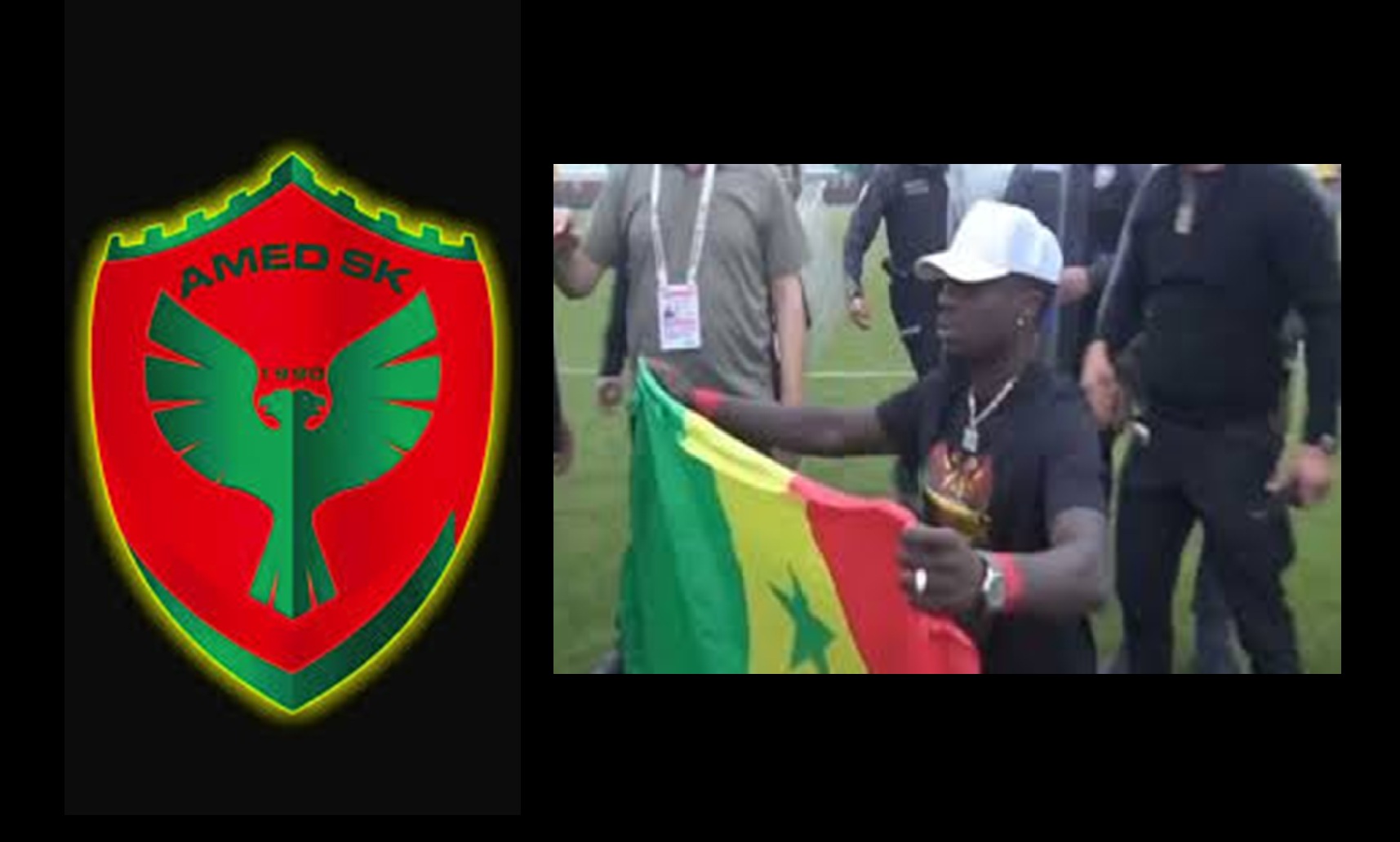
- Finally, this year, after the club’s promotion to Super League, the security forces tried to prevent the club’s Senegalian national striker, Mbaye Diagne, from raising the country’s flag. The security forces probably misunderstood Diagne’s intention, as the Senegalian flag resembles that of the outlawed terrorist organisation, the PKK’s flag.
Comment
While it is understandable that people who lost their relatives are still angry towards the PKK and pro-Kurdish political parties, the success of Amedspor can be a chance for Türkiye’s national unity in its second century, especially at a time when the Turkish President Recep Tayyip Erdoğan and the leader of the Turkish nationalist MHP party, Dr. Devlet Bahçeli, are trying to conclude a peace process with the outlawed PKK and its imprisoned leader Abdullah Öcalan. Let me explain how and why…
First of all, it should not be forgotten that Diyarbakır is a symbolic city for Türkiye’s Kurdish-originated citizens, and its development can only help Türkiye increase its national unity. In that sense, responsible Turkish citizens would be happy with Amedspor’s success, as this would make Diyarbakır part of Türkiye’s popular football discussions and contribute to national unity.
Secondly, remembering Benedict Anderson’s chef d’oeuvre, Imagined Communities, the nationalisation process in the late 18th, 19th and early 20th centuries was also driven by “print capitalism“, which creates a “simultaneity effect” across different segments of the population after reading the same textbooks, the same popular novels, and daily newspapers. In this sense, the simultaneity creates common reactions, behaviours, ideas, and patterns among very different individuals of a state.
Thirdly, while today print capitalism is often replaced by television, internet media, and social media, it can be argued that a similar effect could occur, and the Turkish-Kurdish brotherhood might be solidified through popular discussions of Amedspor’s success. That is why the presence of Amedspor and Diyarbakır city in Türkiye’s top football league, as well as the discussions that will be watched and read by both Turkish and Kurdish-originated citizens of Türkiye, could be a chance for the Turkish State to reestablish its national unity, simultaneously with the ongoing “peace process“.
For all these reasons, let us be optimistic about Amedspor’s success and view this process as an effort to achieve peace through sports. Never forget, as Simon Kuper wrote in his famous book Football Against the Enemy, “football is never only football“…
Prof. Dr. Ozan ÖRMECİ