
The ongoing wars under Benjamin Netanyahu have clearly provided him with additional political breathing room and helped him survive. They may also pave the way for postponing the elections scheduled for next October, an outcome that would align closely with his political interests, particularly as it becomes increasingly apparent that securing victory in the next election will be far more difficult than before. The political landscape inside Israel is shifting in ways that no longer work to Netanyahu’s advantage, compounded by the potentially consequential role of Palestinian voters and other political forces, which could further undermine his electoral prospects. Israel continues to wage war in Gaza and Lebanon, while the possibility of renewed confrontation with Iran remains on the table. Within Netanyahu’s political calculus, attempts by the Israeli government to reignite escalation with Iran may appear entirely rational if such a move serves his political survival and interests.
Benjamin Netanyahu is the longest-serving prime minister in Israel’s history. Under his leadership, the right-wing Likud party has dominated Israeli politics since 2009. A master in politics, Netanyahu may still be able to cling to power for several additional months beyond the scheduled election date in an effort to improve his electoral standing. Legally, postponing elections in Israel is possible only under highly exceptional emergency circumstances and would likely require special legislation passed by the Israeli Knesset, along with a broad political consensus. This has happened only once before, during the 1973 October War, when elections were delayed for two months. Yet such a scenario is far from guaranteed today.
Netanyahu was voted out of power in the 2021 elections due to corruption cases that continue to shadow his political career. Those cases remain open, and he continues to appear in court as part of the ongoing legal proceedings against him. Following his return to office at the end of 2022, Netanyahu assembled what is widely regarded as the most far-right government in Israel’s history. His coalition triggered deep internal polarisation, clashing with broad segments of Israeli society over issues ranging from judicial overhaul plans to the conscription of ultra-Orthodox Jews. At the same time, the conduct of Israel’s wars under his government, particularly in Gaza, and the scale of civilian casualties and destruction have subjected Israel to a level of international criticism unprecedented in its modern history. Netanyahu has also faced mounting accusations of mismanaging the Gaza War. There are growing accusations that the expansion of military fronts and the pursuit of successive wars have, at least in part, served domestic political objectives tied to his personal survival. That is precisely why the opening of any new front in parallel with an election cycle is increasingly viewed inside Israel as a clear political manoeuvre rather than a purely strategic necessity.
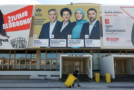
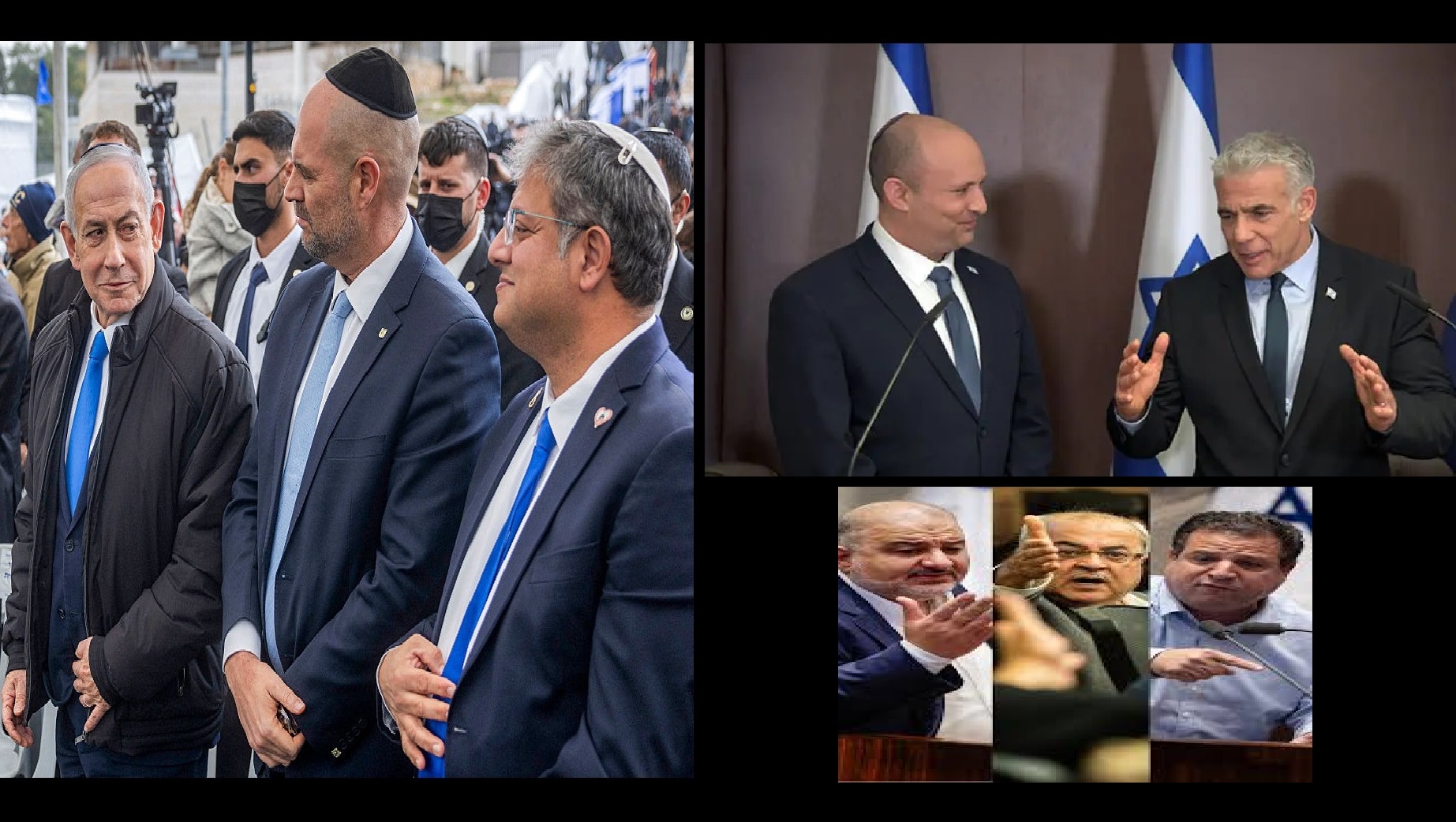
At the end of last month, former prime ministers Naftali Bennett and Yair Lapid announced that they would merge their parties, “Yesh Atid” and “Bennett 2026”, into a new political bloc called “Together“, ahead of the next Knesset elections. This is not the first political partnership between the two men. In 2021, they joined forces to form what became known as the “government of change”, ending Netanyahu’s 12-year hold on power. Palestinians inside Israel played a pivotal role in enabling the Bennett–Lapid coalition to unseat Netanyahu that year. The alliance was then supported by the inclusion of the United Arab List, led by Mansour Abbas, although the party was not granted ministerial portfolios within the coalition government. The newly announced “Together” alliance represents the most significant effort so far to reorganise and consolidate the Israeli opposition ahead of what is expected to be a difficult and highly competitive electoral contest against Netanyahu.
“Bennett 2026” is generally classified as a nationalist right-wing party established last year. By contrast, Lapid’s Yesh Atid is a centrist, secular-liberal party founded in 2012, which emerged as a major political force in the elections the following year. The ideological gap between Bennett’s and Lapid’s parties is therefore clear. It was precisely this gap that led many to describe their previous alliance as fragile, and it was widely seen as a reason for its collapse after only a year and a half in power. That earlier alliance was built around a shared political objective: removing Netanyahu from the centre of Israeli politics. Today, that same objective appears to be bringing them together once again. Bennett and Lapid converge tactically on a number of issues related to domestic governance and the management of state institutions, as well as on opposition to Netanyahu’s policies, despite their clear ideological differences. Bennett and Lapid broadly align with Netanyahu on the wars against Hamas in Gaza, as well as on Israel’s confrontations with Lebanon and Iran, though they differ sharply over the way Netanyahu has managed those conflicts.
Bennett and Lapid also share significant common ground on the Palestinian issue, even though Lapid’s positions are often framed in more diplomatic language. Bennett openly rejects negotiations with the Palestinians, opposes the two-state solution, and refuses the establishment of a Palestinian state altogether. Lapid, by contrast, accepts the principle of negotiations and a conditional two-state framework, but without major concessions, under stringent security conditions, and without a full withdrawal from the Palestinian territories occupied in 1967. Bennett has consistently supported settlement expansion and annexation policies. Lapid’s position is comparatively more restrained, though he likewise supports retaining the major settlement blocs, opposes their dismantlement, and backs continued construction within existing settlements. Netanyahu and his current government have adopted positions toward the Palestinian issue that are widely viewed as even more hardline than those of Bennett and Lapid.
Bennett and Lapid are also seeking to bring Gadi Eisenkot into their political alliance as part of their effort to challenge Netanyahu. Eisenkot, a centrist figure with a strong security background and a former chief of staff of the Israeli military, holds positions on the Palestinian issue that largely resemble Lapid’s. Yet the approaches advanced towards the Palestinian issue by Lapid and Eisenkot remain far removed from those traditionally associated with the Israeli left, even if they are still less hardline than the right-wing camp led by Netanyahu. Between the competing strategies of “managing” the conflict and resolving it, time itself appears to be the primary dividing factor, shaping the differing degrees of rigidity embodied by Netanyahu, Bennett, and Lapid, and the broader political circles surrounding them.
Gadi Eisenkot currently heads the centrist “Yashar” party following his departure from Blue and White, led by Benny Gantz. He has not yet made a final decision on whether to join the “Together” alliance. Yisrael Beiteinu, led by Avigdor Lieberman, Blue and White, “Democrats”, and “Yashar” share a common objective centred on removing Netanyahu from power. That same objective previously brought these factions together in the coalition government formed under the Bennett–Lapid alliance. Taken together, the opposition parties appear more flexible and diplomatic in their approach to the Palestinians and to regional issues than Netanyahu’s current government. Since Netanyahu’s coalition returned to power, the Palestinian issue has entered one of its bleakest phases, while the wider region has been plunged into a level of tension and warfare unseen in decades.
Lapid and Bennett have so far ruled out including Palestinian parties in Israel in their joint “Together” electoral list, unlike the arrangement that helped them defeat Netanyahu in the past. Yet this does not diminish the potentially decisive role of Palestinians in the upcoming elections and in any effort to unseat Netanyahu’s government. In a political system where every vote can prove consequential, the electoral weight of Palestinian parties inside the 1948 territories is increasingly evident. The growing strength of these parties, alongside higher levels of political coordination and voter mobilisation, could serve not only the domestic interests of Palestinians in Israel, who constitute the country’s largest minority, accounting for more than one-fifth of the population, but may also evolve into a future source of pressure on Israeli government policy toward the national Palestinian issue itself.
In Israel, it is not uncommon for governments to collapse before completing their legally mandated four-year term, triggering early parliamentary elections. Israel is widely regarded as one of the fragile parliamentary systems, largely because of the structure of its electoral system, which is based on full proportional representation within a single nationwide electoral district and a relatively low electoral threshold, currently set at 3.25 per cent. This system has produced a highly fragmented Knesset, with a large number of parties represented in parliament and governments formed through coalition arrangements that often rest on narrow parliamentary majorities. These recurring patterns unfold against the backdrop of deep structural divisions within Israeli society, spanning religious versus secular communities, Mizrahi versus Ashkenazi Jews, and Jewish versus non-Jewish populations. That electoral system gives large parties and major alliances, particularly those positioned as the second- or third-largest blocs, significant leverage to obstruct the formation of a government if they refuse to join either of the leading contenders. At the same time, it grants smaller parties considerable bargaining power, since the withdrawal of even a minor coalition partner can bring down an entire government. Within this framework, Israeli politics has become increasingly fragile and unstable. That instability was especially evident between 2019 and 2022, when Israel held five legislative elections in rapid succession.
Palestinian parties in Israel are increasingly moving toward forming a unified joint list for the upcoming elections. Earlier this year, following a massive demonstration and a widespread strike in the city of Sakhnin protesting the sharp rise in crime and killings within Palestinian society, amid what many Palestinians described as Israeli government and police negligence, if not complicity, an overwhelming sentiment emerged in favour of reunifying the Palestinian parties under a single electoral framework. During that same event, the Palestinian parties in Israel signed a joint pledge committing themselves to work toward reviving the Joint List ahead of the upcoming elections. The initiative brought together Ayman Odeh, head of the Democratic Front for Peace and Equality “Hadash“; Ahmad Tibi, leader of the Arab Movement for Change, “Ta’al“; Sami Abu Shehadeh, chairman of the National Democratic Assembly “Balad“; and Mansour Abbas, head of United Arab List, “Ra’am“.
Recent opinion polls project major gains for a unified Palestinian electoral list, potentially increasing Palestinian representation in the Israeli parliament from 10 seats to as many as 15. Under such a scenario, the Joint List could emerge as either the second- or third-largest bloc in the Knesset in terms. The alliance was originally formed in 2015, bringing together the leading Palestinian parties in Israel and securing the largest parliamentary representation Palestinians had ever achieved in the Knesset. The Joint List won 13 seats in the 2015 elections, before increasing its representation to 15 seats in 2020, becoming the third-largest parliamentary bloc in the Knesset at the time. The alliance later fragmented ahead of the following elections. The number of seats could rise even further if Palestinian voter turnout increases. There is a clear positive correlation between the unity and cohesion of Palestinian parties and higher levels of popular participation.
If completed, the formation of a unified Arab electoral list in the upcoming elections could become a major instrument in removing Netanyahu’s government by fundamentally reshaping the parliamentary map. Such a development could deny Netanyahu’s bloc the 61-seat majority required to form a government, while compelling the winning camp to coordinate politically with the Palestinian parties.

Dr. Sania Faisal EL-HUSSEINI
Dr. Sania Faisal El-Husseini is a Professor of Political Science and International Relations at the Arab-American University in Palestine, and a writer and researcher who has published numerous political articles and research papers. El-Husseini worked with the Palestinian National Authority for more than two decades in information and diplomatic roles. She has worked as a lecturer at several universities in Palestine since 2008, including Birzeit University and Al-Quds University. She was invited as an academic visitor by the Oxford Centre for Islamic Studies in 2013-2014 and Georgetown University in 2017-2018. Recently, El-Husseini became a faculty member of the Department of Conflict Resolution and the Department of Diplomatic and International Law at the Arab-American University.