
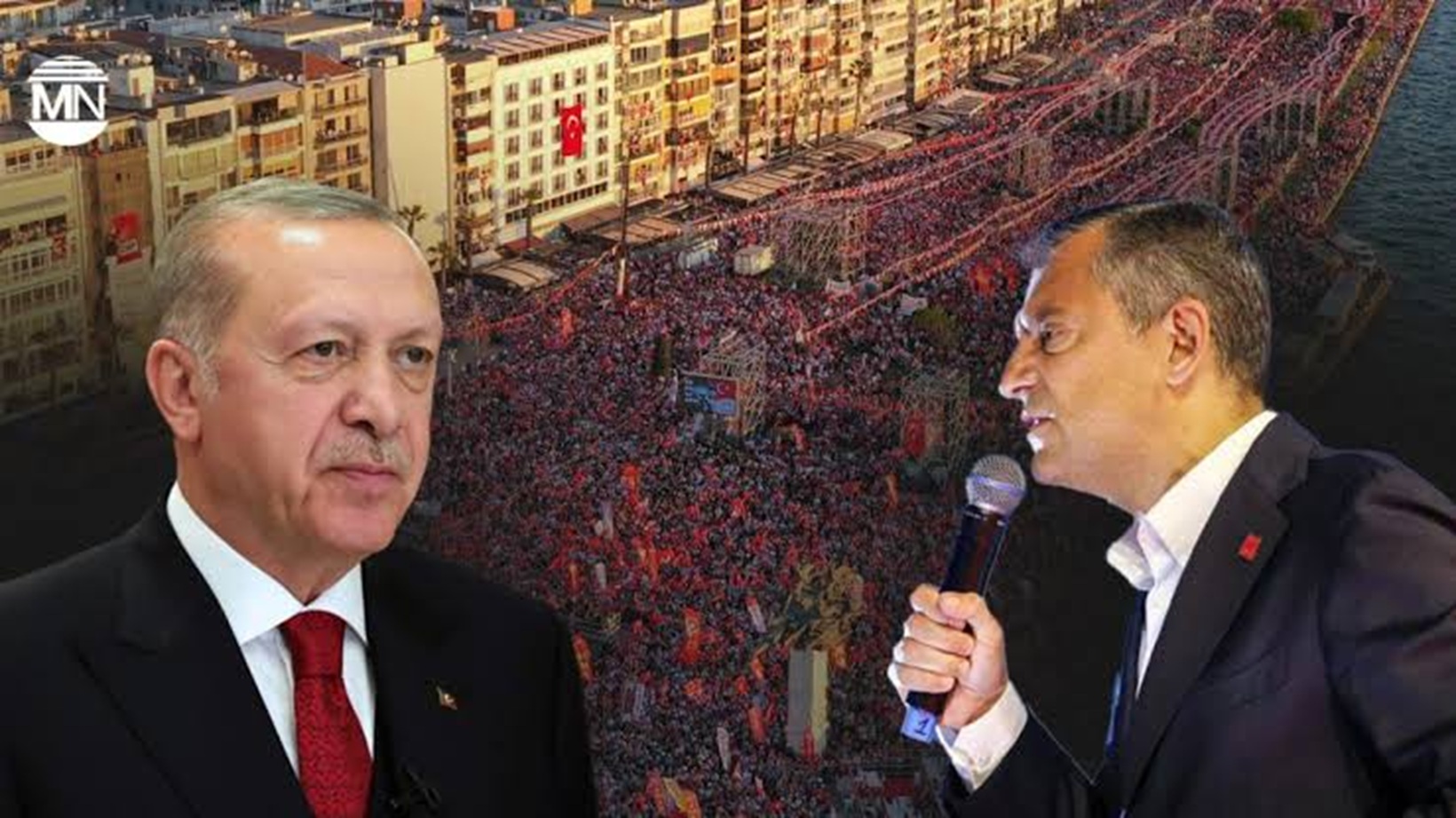
In Türkiye, which has been busy in recent months with operations against opposition municipalities and economic problems, all signs indicate that preparations are underway for Recep Tayyip Erdoğan, the 12th President who has effectively governed the country since 2003, to serve a third term as President under the presidential system of government. In this article, I will summarize the current developments in Türkiye.
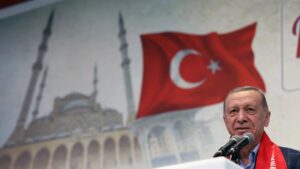
Recep Tayyip Erdoğan, Türkiye’s most powerful leader since Mustafa Kemal Atatürk, began leading the country in 2003, initially serving as Prime Minister. A charismatic leader with Islamist roots, Erdoğan rapidly became virtually unrivaled in a political race he had entered at a significant disadvantage; he achieved this through strong ties with conservative segments alienated by Türkiye’s traditional strict secularist and nationalist policies, Islamic sensibilities (such as the Palestinian cause) that raised his profile in international politics, an astute nature that intuitively grasped political dynamics, and a knack for forging alliances. He has dominated Turkish politics for nearly a quarter-century. First elected President under the parliamentary system in 2014, he was later elected President under the new presidential system — adopted after the 2016 failed coup attempt and the 2017 referendum — in 2018. In 2023, Erdoğan was elected President for a second and final term, reshaping the country in line with his own vision.
However, for Erdoğan—whose eligibility for the presidency will expire in 2028 due to the two-term limit set by Article 101 of the Constitution—to remain in power and run for a third term, a decision for early elections must be adopted by the Grand National Assembly of Türkiye (TBMM) with a vote of more than three-fifths of its members (i.e., 360 out of 600), in accordance with Article 116 of the Constitution. In that case, the President, who has not yet completed their term, may run again.
In a recent statement indicating that Erdoğan would run for a third term, Chief Advisor to the President and legal expert Mehmet Uçum noted that the election could be held on April 16, 2028, via a decision by the Grand National Assembly of Türkiye (TBMM); he further stated that imprisoned Kurdish leader Selahattin Demirtaş could also submit an application under the “framework law” (çerçeve yasa) enacted during the “Terror-Free Türkiye” (Terörsüz Türkiye) initiative. This statement marks a significant move that reflects President Erdoğan and his team’s third-term strategy.
When examining the distribution of seats in the Grand National Assembly of Türkiye (TBMM) for Erdoğan’s third-term candidacy, the AK Parti/AKP (290 MPs) and the Nationalist Action Party/MHP (46 MPs) fall short of the required 360 votes, reaching only 336. However, including independent MPs (11) and the “New Path Alliance” (Yeni Yol) (20) — formed by other small right-wing parties — brings the total to 356, very close to the 360-vote threshold. Adding the New Welfare Party (YRP) (3 MPs) and the Felicity Party (Saadet Partisi) (1 MP) could bridge this gap and reach the 360-vote mark. Furthermore, the CHP, which has recently experienced internal rifts and, under Kemal Kılıçdaroğlu’s leadership, has at times aligned more closely with the AK Parti and Erdoğan, could also trigger an early election with just a few votes. Another option for Erdoğan is to seek support from the Kurdish political movement—with which he has re-established ties through the “Terror-Free Türkiye” initiative—and secure an early-election decision by reaching an agreement with the DEM Parti, which holds 56 seats in parliament. This is a critical factor for Erdoğan’s re-election prospects; given the economic difficulties, the erosion of democracy and the rule of law, and the political fatigue accumulated over the years, it would be extremely difficult for him to surpass the 50% vote threshold at the ballot box. He could only achieve this by combining his traditional right-wing base with Kurdish support. To this end, issues such as the status of imprisoned PKK leader Abdullah Öcalan and the granting of certain cultural and political rights to the Kurdish people — topics that emerged during the process initiated by the “framework law” — might once again come to the fore. In a strange twist of fate, these matters, which right-wing circles in Türkiye have traditionally viewed with skepticism but which are essential for the country’s normalization and democratization, might well come to pass, perhaps for the first time in history, thanks to a leader pursuing his own political interests!
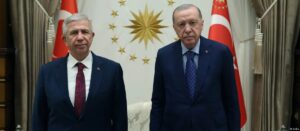
Yavaş and Erdoğan
However, Erdoğan’s challenges extend beyond securing a decision for early elections and winning back Kurdish support. Even if an early election is called and a portion of the Kurdish vote is won back, Erdoğan faces formidable potential rivals. For instance, the imprisoned Mayor of Istanbul (IMM)—now associated with the “New Party” (Yeni Parti, formerly CHP)—Ekrem İmamoğlu remains highly popular despite corruption allegations and could defeat Erdoğan at the ballot box. Similarly, Özgür Özel—who founded the “New Party” and became the main opposition leader after a court ruling blocked his CHP leadership bid—is a strong candidate. Third, Mansur Yavaş, the CHP Mayor of Ankara, comes from an “Ülkücü” (nationalist) background; he is a strong candidate capable of defeating Erdoğan in an election. Persuading these figures not to run against him will undoubtedly be difficult for Erdoğan. İmamoğlu has been sidelined for now because of legal proceedings. However, Özgür Özel remains a contender. As for Mansur Yavaş, he has sent mixed signals, having met with Erdoğan recently; yet those who know him well say he aspires to be a presidential candidate should the right conditions arise. Consequently, Erdoğan may bring strong candidates like Özel and Yavaş into his fold or persuade them to abandon their candidacies. How this could happen remains a mystery.
Ultimately, all indications in Türkiye suggest that preparations are underway for President Erdoğan to run for a third term. This could undoubtedly help complete the “Terror-Free Türkiye” process; after all, resolving Türkiye’s century-old Kurdish Question requires a tough leader like Erdoğan — someone who operates outside the established system and acts without fear. It should not be forgotten that, without Erdoğan, even lifting the headscarf (türban) ban in Türkiye might not have been possible. However, while the measures taken to address these major issues have been historically beneficial, the rapid decline in Türkiye’s democracy and rule of law—particularly since 2016—is negatively affecting the country’s standing in the international system and its economy. For instance, this situation lies at the root of the European Union’s negative stance toward Türkiye, a stark contrast to its willingness to invite even a North American nation like Canada to join based on shared democratic values. Similarly, the perception that Türkiye is drifting away from democracy plays a significant role in anti-Türkiye sentiment within the U.S. Congress and in support for states such as Israel, Greece, and Cyprus. Therefore, Erdoğan and his team must show greater sensitivity to democracy and the rule of law. We hope Türkiye continues to contribute to global peace as a strong, democratic state.
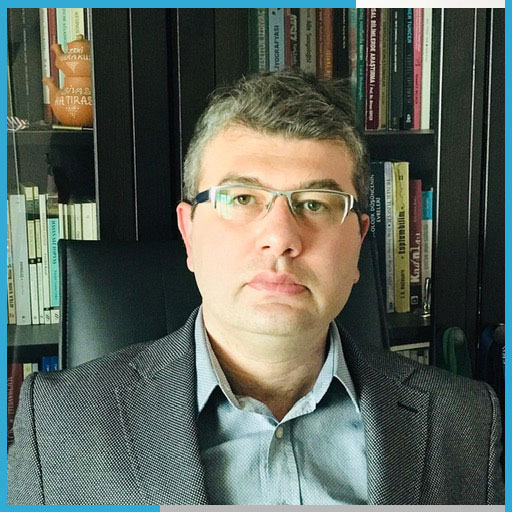
Prof. Dr. Ozan ÖRMECİ